Wednesday, June 20, 2012

The Land of the Giants


Wind Farms as seen from the train on the bridge from Malmo
From the moment we crossed the bridge on the train into Copenhagen we saw them. Huge, white, turning in syncronized motion and lined up in rows in the waters seperating Denmark and Sweden. The tall white giants which are the basis of Denmark's wind energy; the wind turbines and wind farms.


Down the road from the farm we are
staying at, we found these turbines.
Interesting how they look when they are
all lined up in a row.
  They are everywhere dotting the landscape of the city and countryside alike. Wind energy provides most of the electricity to this area. Most of the wind turbines are owned and regulated by the government but you will sometimes find one owned privately by a land owner. Besides, wind energy, the area we are staying in Hostelbro also utilizes biogass or biomass energy. How many of you know that in Texas we get some of our electricity from wind turbines like these?  Where in Texas do you think you would find them? 


Lemvig Biogas Facility in Lemvig
 Today we visited the Lemvig Biogass plant where huge storage tanks collect the biomass collected from the area. Since 1992, Lemvig has been the largest biogas facility in Denmark.   They process the excess materials and waste from homes and farms thus eliminating the need for waste disposal plants and public landfills. There are no greehhouse gasses that are emitted from the facilitiy so it is a natural choice for being eco-friendly to the environment. They are located near a harbor in Lemvig and can accept between 200-10,000 tons of organic waste at a time.  While the processing plant may not look that impressive you can certainly tell you are there by the smell in the air. Do you think biogas could be produced in our area?  Did you know that in some areas of the United States they are building biogas plants. Think of all the landfills that could be eliminated if we utilized this type of energy.
They also utilize solar energy at the
biomass plant/


Ms. Edge indicates how it smells near
the holding tanks. 
Tomorrow we will be visiting the Energy Museum outside of Viborg, Denmark to see what we can discover about other forms of renewable energy with their many interactive exhbitss, displays and demonstrations.

Heading to Denmark

The next morning we were up at the break of dawn (oh, wait .... it really never gets completely dark, so that statement does not apply) or 4:30 a.m. in order to get the bus to the ferry to the trolley and finally to the train station. Wow, that sounds tiring just typing it!
Our train for Copenhagen, Denmark leaves the station this morning at 7:00 and this time we will be carrying all of our baggage with us. One word of advice for those traveling to many different locations and using public transportation. PACK LIGHTLY!!! It will come back to haunt you if you do not. There is nothing more frustrating than trying to lug a duffel bag of suitcase up the steps to the train along with a carry-on bag and backpack as well. Today will be a major travel day with our first stop being in Gothenburg, Sweden to change trains and then head to Copenhagen Airport where we will be renting a car to get us across to the places in Denmark we want to visit that are not easily accessible by public transportation. We notice a difference between today's trains and the ones we took to Bergen and back. These are a lot more crowded and not nearly as comfortable and with less amenities as before.

 It is interesting to watch the people come and go at the various stops and it makes you curious about how their lives are similar and different than ours. On the train, we meet a young man named Adam who is traveling to Malmo (the stop before ours) to visit friends. He tells us that at his apartment (which is quite a bit smaller than our homes and apartment at 300 square feel, his electricity is produced mainly by biogass. This is one of the energies we are hoping to explore as we visit Denmark over the next few days. He tells us that the average cost of his electricity is about $400 per year. Of course it would be interesting to see what that would be when you factor in the size of the home. Of course coolig is what drives the cost and usage up in our area and that is not needed here. They focus on the heating aspect since they have a much milder temperature here in the summer. In fact, today we are bundled up in sweaters, scarfs and jackets and it is June 15th.
 After we arrive at the airport around 3:30 in the afternoon and secure our vehicle we are off across Denmark towards the small town of Hostelbro. Our drive to the farm will take us about 4 hours.


Here we will be staying at the home of Jenn Peter Sonne, who is a horse farmer and raises Icelandic horses. We know what farming life was like in the 10th century and now we will investigate 21st century farming techniques. It will be interesting to see how energy needs and consumption changes in the rural areas of the country compared to Copenhagen, which we will visit at the beginning of next week.


One difference we noticed when looking out the window. What do you think it was?


The Power of Water, the Fjords of Norway

Bestefenn and Griffy are excited to
be on the train.
Our Conductor
On Wednesday we packed a snack and headed to Bergen via Myrdal, Flam, Gudvangen, and Voss. We took two trains, a ferry, and a bus to our final destination.


On the way we witnessed the incredible force that melting ice caps can bring with them. The first to take advantage of this renewable energy source was the lumber industry. The Norwegian loggers used this energy to move large numbers of logs from the mountainous forests to the ports to be processed and sold. Then it was harnesses and channeled into dams to produce hydroelectricity which is still a major energy source in that country. In fact, Norway and Denmark trade renewable energy. You now know what Norway sends to Denmark. What do you think Denmark sends to Norway?
This is where waterfalls begin., At the
top of the mountain.
Ready to board the old time train
for Flam.  Notice all the snow!


The Flam Railway was quite different
but very quaint.
At Myrdal, we exited the NSB train and boarded the Flam Railcar that took us on an incredible journey to Flam.  From our train we saw beautiful waterfalls and rapidly moving mountain streams that reminded us of the mountains in Colorado.  The air is so fresh and clean.


On the Fjord cruise learning about the
power of water.
Another of the many waterfalls
Even in the rain the fjord is beautiful!
Our boat trip was on the most beautiful fjord. In fact it is on the UNESCO world heritage list, and we totally agree. Everywhere you looked you could see the waterfalls orginating from the tops of the mountains we had just crossed on our train ride. We saw where they waterfalls begin.  It was definitely the right time of the year to experience the majestic beauty of the fjord. The only thing that would have made this better would have been a clear day. Because it was raining and windy, it was also quite cold so we warmed up with some hot cocoa and coffee. You probably wonder if it really is that cold as you look at how we are bundled up.  Yes it was!!!!


Bergen is on the opposite side of Norway
than Oslo.

What a fun way to get around!
We got to the old fishing town of Bergen that evening, but no worries there was plenty of light to find our tiny bed & breakfast for the night. It was located in the oldest part of town where the streets are so tiny, and very short and winding. We felt like we were in a fairy tale story, or a nursery rhyme.
Boarding the train back to Oslo
Our visit to the fisherman's wharf reminded us of all the human energy it takes to put food on the table. Spending the day out on to open ocean, then hauling it in, cleaning it and then getting it to the market ( that would be an open market, not a grocery store)so it can be shipped to other places makes for a long and smelly day. Our return trip to Oslo was faster, but not quite as colorful. We saw that all walks of life used the train on a daily basis, and not just for vacations, like us. It was fun seeing dog, cats, and babies get on and off the train. Then we were back in Oslo and glad to visit with our friend Renate again and share all our funny stories.

Friday, June 15, 2012

Energy in Norway

The inside of our ferry in Oslo.
 As we begin our second day in Norway, we are beginning to appreciate the prices back home. A hamburger for $28.00 is a common find and those are at the TGIF Friday's so we know what you get and can compare it to the price back home. We are thankful we had the forethought to pack snacks before leaving home. There is just something wrong with paying that much for a meal. The cost of transportation is high as well with one hour fares within zone one costing about $7. We soon found the multi ticket of 6 rides comes out cheaper. Since we must travel each day, we have been walking alot to shed any extra weight from an ice cream cone or two. To the left you can see what the inside of the ferry looks like that we take each day to get back and forth from our hostesses house.

Enjoying the Scream
Today we wanted a little culture so we visited the Munch Museum. For those who participated in our Fine Art unit, you may remember his most famous painting, The Scream.

We also walked through the Botanical Gardens where we saw many different varieties of plants from all over the world. We saw several tropical plants such as bromeliads that we will be learning about in our Ecosystems unit next year. 
The Nobel Peace Center was also one of our stops where we saw a beautiful lighted tribute to the winners through the years.

Paraffin burns here to heat the home
Parafffin is used to heat many homes
  At the home of our hostess, she explained how they use paraffin to heat their homes throughout the winter. In her basement she showed us the tanks they must fill about twice a year. It is less expensive to fill it during the summer. They generally heat the bottom floors and allow the heat to rise to make the most of their energy source. They also have coils under the hard surface floors to heat them. They feel great on your socked feet in the morning.
When they don't burn wood, they burn dry paper here.
Another way to recycle.
She will burn dry paper goods, mail and left over mail in the main chamber of her fireplace stove again allowing the heat to permeate the home. Obviously, air conditioning is not needed here. Unlike Iceland, the electricity here is more expensive. They seem to be better conservationists than major producers of renewable energies. The main source of renewable energy found here has been hydropower. There are many hydropower plants found near the lakes and fjords. They have also just introduced the first hydrogen powered bus this May. This area is very beautiful with flowers blooming everywhere. We will post more pictures soon, probably on our Flickr page. It is amazing how much we have seen. We are loving every minute and are constantly reminding ourselves we are really here!
Creating energy
Technology Museum
The next morning we were again up early to catch the ferry and then the tram to the Technology Museum to see their excellent exhibit teaching about Energy.  Of course one problem with public transportation is it is not always working when you need it to.  We needed to catch the number 12 trolley to the last stop but when we got to the place to catch the trolley we discovered it was not running for some reason.  Off to find another alternative, only to discover that the bus you can take does not come to that stop, so back to the trolley stop and there it was.  It took us about an hour to get someplace that should have taken 20 minutes and it was not raining. 
Once we were there, we were surrounded by what seemed all of the elementary aged children in Oslo. They were everywhere exploring and participating in the many different hands-on activies. We naturally headed straight to the Energy exhibit.  Here we were able to get information on all forms of renewable energy as well as participate with interactive displays. We wish we would have had a little more time to explore  more of the museum.

Monday, June 11, 2012

We said good bye to Iceland the next day and after we landed in Oslo airport, we looked for our train into the city center. It was very easy to transfer from the airport to the train station, and soon we were on our way. We emerged from the platform to find a vibrant central station before us.

The Norwegian transit system is very efficient and varied in the ways you can get around. There is the bus, the Tube [subway], the train, the ferry, bikes and the ever popular mode: walking.


The train station was situated right across from the tram and bus station and only a block away from the Tube station. If you didn't go by any of these modes of transportation, there were bikes and pedestrian everywhere. The city center was in fact "Pedestrian only" on 4 of the streets that lead to the  hub where we were located.


 We were surprised when we found out that many people commuted across the fjord daily, and left their bikes on the Oslo side for the second leg of their daily commute.


We had agreed to meet up with our hostess Renate Ostergard in front of the train station later that afternoon when she got off work. In the mean time we enjoyed what would be one of the clearest days we had in Norway. Time flew by as we watched this busy city whiz by us, much of it run by electricity, instead of gas.


 We thought we had hit the jackpot when we found the electric car plug-in station parking lot where at least 20-25 cars could charge while their owners were at work.
The next morning we didn't head for Oslo, but to Drobec which is a small village south of the capitol city, to get a feel for the local community. This usually sleepy little town was wide awake as it was market swap day. We got to to see many cottage industry products like hand made soap, crocheted clothing for all ages as well as hand made toys and pottery.  There were also the usual personal treasures up for trade as well. Everyone was friendly and most were able to speak English quite well!


Renate shared an even better secret with us when we had wandered a bit. this town was the home of the original Christmas Store! We headed straight for this absolutely magic store and had a wonderful time  reminiscing about favorite childhood stories of this very special season. We also found out that Santa came by the post office located in the store to drop off letters to boys and girls that have been extra specially good that year. We found one of his elves hard at work when we stopped by!


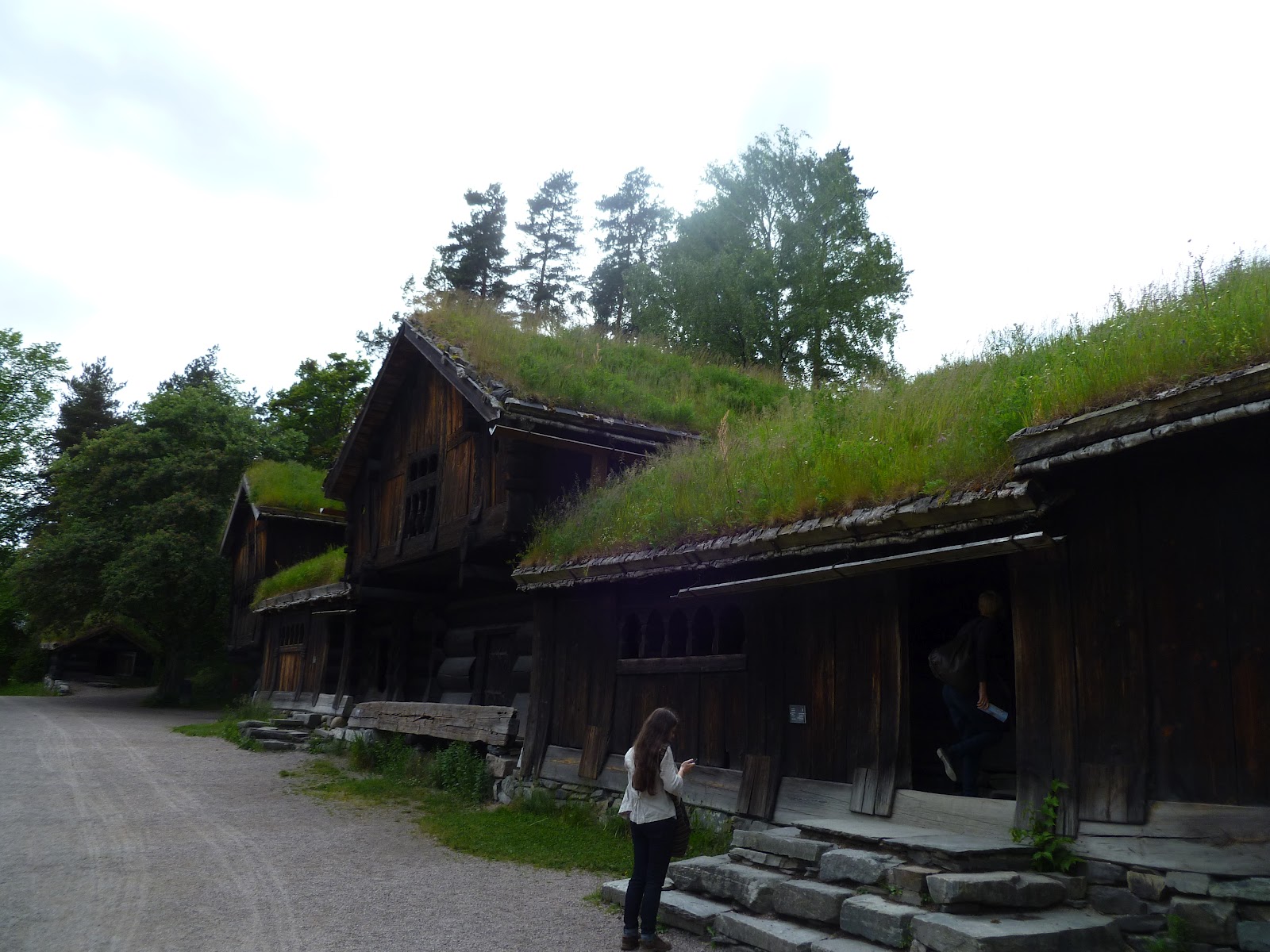
 Then we walked around the village itself and fell in love with the old well kept homes and businesses.  But as captivating as the village of Drobec we had to tear ourselves away because we were headed to the Norway Open Air Folk museum to find out what kind of carbon footprint Norwegians hundreds of years ago left. We wondered if they knew how to recycle in the 10th century, and being the tough detectives that we are, we would let nothing stand in our way! Not even a few measly centuries.

What we found was that the ancient farmers of Scandinavia were the original recyclers. Everything came from the land and the land was everything. These people took everything from the forest that they needed and what they didn't need just became compost and went right back into the land.

The buildings were insulated in quite clever ways. For instance, the roof was protected by growing plants on it. It kept the farmers dry in the wet times and warm in cold times as well as cool in warm times. During the long dark winters they spun linen from flax [ a plant they grew for the grain first] and carves wonderful objects from wood.

We left the Folk-museum in awe of these first Norwegians. We knew it was a hard life back then, but we didn't realize how efficient they were in the process. This visit inspired us to persevere in our quest for 0 carbon footprint answers!


The Golden Circle of Iceland


On the bus heading to the Golden
Circle
You can see the pipeline for the heated
water and the power lines all coming
from the geothermal plant.
Day 2 in Iceland.  This morning we were up early and headed out for the Golden Circle Tour.  This gave us the opportunity to observe first hand how geothermal energy is harnessed and used throughout this country. 
 As we headed east from Reyjkavik we immediately observed the pipelines and power cables along the road.   
One of many plants turning heated
water into electricity.
 This is the process used to transport the hot waters from the geothermal plant to the city and towns.  Power lines sending electricity were located along side the pipes. We were able to see the first power plant fromm a distance. (see our Flickr page for more pics)
The Geysir in action
Gullfoss Waterfall is one of the
top 10 waterfalls in the world.
Our tour also enlightened us with the history of Iceland and its first Parliament location.  We were  able to see where the North American and European Continental plates are drifting apart.  The bottom picture to the left was taken near the rift.  The part that is in the middle is called a "micro plate".  This stop was followed by a visit to the Gullfoss Waterfall which is the result of melting glaciers.  This is the location of one of the first ecological preservation efforts, successfully spearheaded by a young local girl who was able to save the falls from commercial use.  Next stop was the "Geysir" where again geothermal activity was observed.


At the Geothermal Plant
  Our final stop was the Hellisheidarvirkjun Geothermal Power Plant. Here we were able to observe  how the extremely hot waters from the earth are processed and sent to homes throughout Iceland. Our tour guide explained that two of the three geothermal power plants had a componant that takes the gasses out of the geothermal heated water but one of the plants which serviced Reykavik did not therefore the smell of sulphur was what we had been smelling in the shower.  This particular plant services the local towns and Reyjkavik.  After our 9 hour tour it was back to the room to pack up and find a place to eat before getting to bed and prepared for a 4:45 a.m. departure for the airport.  Now it is on to Norway, where the Energy Detectives will pursue ...... Hydropower at work.  Stay tuned for more details.